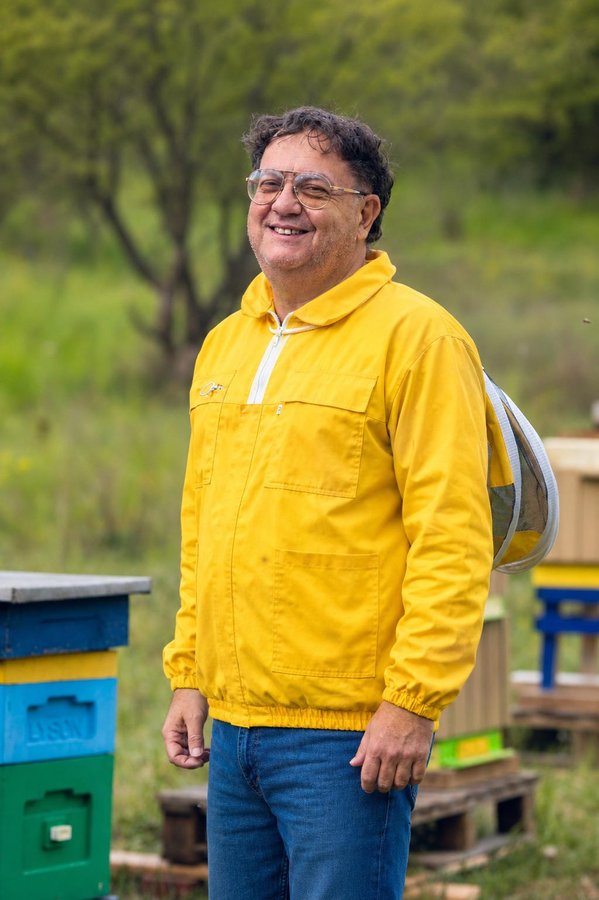
Why bees?
When I opened a hive for the first time, I expected to find thousands of insects making honey. I quickly understood that honey was only a small part of the story.
The invisible work that feeds the world
Every morning, billions of bees leave the hive with a task that has nothing to do with honey: carrying pollen from one flower to another. This service — silent, free, planetary in scale — is called entomophilous pollination, and without it most flowering plants would be unable to reproduce.
Estimates vary depending on methodology, but leading international scientific institutions agree on a core finding: approximately 75% of the world's food crop species depend, to varying degrees, on animal pollination. In Europe, according to EFSA, around 80% of cultivated plant species are pollinated by insects — and bees are by far the most important pollinators.
In practice this means: apples, pears, cherries, apricots, strawberries, blueberries, tomatoes, courgettes, melons, almonds, sunflowers, oilseed rape, beans, soya. All stone fruit. Most legumes. A large portion of oilseeds. The food diversity we take for granted depends significantly on the fact that millions of bees go out to work every morning.
In many crops, adequate pollination can improve not only yield but also fruit size, shape, texture and storage quality, with results that vary between species and production systems.
Honey bees and wild pollinators
It is important to distinguish between the honey bee (Apis mellifera), managed by beekeepers, and wild pollinators: bumblebees, solitary bees, hoverflies, butterflies and many other insects. Both contribute to pollination, but in different ways and proportions depending on the crop and the territory. For some crops wild pollinators are more effective than honey bees; for others it is the reverse. In any case, a greater diversity of pollinators generally provides a more stable and resilient service.
Protecting pollinators therefore means caring for both managed hives and — crucially — the habitats of wild species. Responsible beekeeping is part of the solution, but it is not sufficient on its own.
A society that works without bosses
The hive is one of the most studied systems of collective organisation in biology. There is no command centre. The queen does not give orders: she lays eggs. Every decision — where to forage, when to swarm, how to defend the entrance, how warm to stay in winter — emerges from the coordinated behaviour of tens of thousands of individuals following simple rules and responding to environmental signals.
Scout bees communicate the location of a good nectar source through the waggle dance: a coded movement that transmits direction, distance and quality of the source. The angle relative to the vertical sun indicates direction; the duration of the waggle run indicates distance; the intensity of the dance signals quality. It is one of the most sophisticated referential communication systems known in the animal world.
Thermoregulation of the brood area is equally precise: bees keep that zone generally close to 34–36°C, warming it with their thorax muscles when it is cold and promoting ventilation and water evaporation during warmer periods. Remarkable precision, achieved without instruments and without centralised planning.
Science has started studying these mechanisms to apply them to problems of artificial intelligence, logistics and optimisation. This is not a metaphor: algorithms inspired by bee behaviour are used to optimise distribution networks and routing.
Why they are at risk
Many wild pollinator populations are in decline, while managed honey bee colonies face significant seasonal losses in several regions. These are distinct phenomena, but both reflect pressure from habitat loss, parasites, pathogens, pesticides and climate change:
- Habitat loss. Intensive monoculture has drastically reduced the variety of flowering plants available. An extensive monoculture may offer limited resources concentrated in a very short period, leaving little food available for the rest of the season.
- Pesticides. Some classes of insecticide — particularly neonicotinoids — have documented effects on navigation, memory and reproductive behaviour of bees even at sub-lethal doses. The EU banned outdoor use of three neonicotinoids from 2018, but many substances remain in use globally.
- Varroa destructor. A parasitic mite from Asia that spread globally in the 1970s and 1980s. It reproduces in brood cells and weakens adult bees. Without treatment, an infested colony collapses within two or three years. Managing varroa is one of the primary responsibilities of every beekeeper.
- Pathogens and viruses. Varroa also acts as a vector for viruses that would otherwise not access bees' circulation. The parasite-virus combination is one of the main causes of colony collapse.
- Climate change. It advances flowering times, disrupts the synchrony between bloom and bee flight, and extends drought periods.
COLOSS surveys show that winter colony losses can reach double-digit figures, with significant variation between years and countries.
What Florabella does
Koziegłowy is a mixed agricultural area with stable meadows, hedgerows, orchards and uncultivated edges along watercourses. We chose this site partly for this reason: botanical diversity within flight range of the bees.
We monitor varroa with regular counts and treat only when necessary, using oxalic acid — permitted in organic beekeeping — during broodless periods. Every inspection is recorded in our hive management app, which tracks each hive's condition over time.
Every batch is small, numbered and seasonal — the direct consequence of working with the hive's natural rhythm rather than forcing it.
What you can do
- Plant for bees. Lavender, thyme, oregano, borage, phacelia, dandelion left to flower, sage, nepeta. Even a pot on a balcony counts.
- Let the grass flower. A lawn mown at intervals rather than shaved every week is already a habitat for pollinating insects.
- Support local beekeepers. Buying honey from an identifiable producer supports hive management in the local territory. To help wild pollinators too, what matters most is diverse habitats, continuous flowering and reduced chemical pressure.
- Ask where it comes from. Honey without a declared origin, without an identifiable beekeeper, without a season — tells no story and supports no specific apiary.
We started with two hives in Koziegłowy. Not to produce honey at all costs, but to understand how a hive works from the inside — and to be part of it in the most respectful way possible. Discover Florabella wildflower honey →
Sources
IPBES, The assessment report on pollinators, pollination and food production, 2016. DOI: 10.5281/zenodo.3402837 · EFSA, Conclusion on the peer review of the pesticide risk assessment for bees, EFSA Journal, 2013 · Klein A.M. et al., Importance of pollinators in changing landscapes for world crops, Proceedings of the Royal Society B, 2007. DOI: 10.1098/rspb.2006.3721 · COLOSS, Honey bee colony losses 2022–2023, Journal of Apicultural Research, 2024
Want to see where this honey comes from?
The Hive Circle follows two hives through a full season, up close. Limited places for Founding Members 2026.
Discover the Hive Circle →