Where our bees fly: the Koziegłowy foraging map
On 5 July, while observing the territory around the apiary, our bees could have been at work on the linden trees, in the meadows, or on one of the crops in bloom around Koziegłowy. We can't follow every flight, but we can reconstruct with reasonable precision the landscape of resources they found outside the hive, because we observe it and log it week by week.
This season we've started keeping a calendar of what's in bloom around the apiary. Not out of botanical curiosity for its own sake, but because it's a concrete tool for understanding what the colonies likely have available at a given moment — and for spotting, in time, the periods when natural resources risk running short.
The territory observed on 5 July
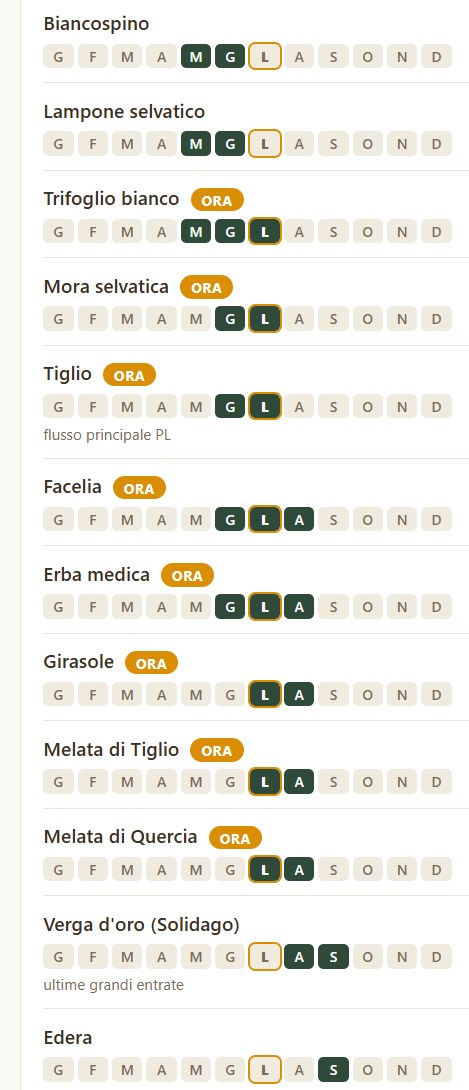
According to our notes from that week, linden was closing its main bloom, while in nearby fields we had observed phacelia in flower. Alfalfa and the first sunflowers had joined only days earlier, according to what we recorded during the last inspection. Alongside this, we had observed the presence of honeydew on linden and oak — a sugary substance produced by small insects, such as aphids, as they feed on plant sap, which bees can gather when floral nectar slows down.
It was, as we read it at the time, a moment of relative abundance. The picture changes in the following weeks: by late summer, once most blooms have run their course, our calendar points mainly to goldenrod and ivy as the main resources still available before winter.
What this calendar actually is
It isn't GPS tracking, or anything particularly sophisticated. It's a record we keep in the apiary's digital log: for each relevant plant in the area, we note the approximate bloom window, whether it offers mainly pollen or mainly nectar, and a few contextual notes — distance from the site, observed presence, whether we consider it a reliable or more occasional source.
We update it by observing the territory during routine inspections. The dates recorded this year will become the first reference point against which to compare future seasons: some blooms may shift earlier or later depending on how spring unfolds, while others may prove more consistent. It isn't data fixed once and for all — it's a calendar that will become more precise season after season.
The foraging radius
Bees from a hive don't limit themselves to the meadow right in front of the entrance. When they find abundant, convenient resources nearby, foragers tend to favour relatively short distances. There isn't, however, a standard radius: depending on the season and the quality of the landscape, they may work within a few hundred metres of the hive or travel several kilometres when they find a particularly worthwhile source.
Around Koziegłowy — which sits east of the Warta river, in the Poznań metropolitan area — the territory our observations cover is fairly mixed: non-intensive polyfloral meadows, tree lines along the river, some cultivated fields (rapeseed in spring, sunflower and sometimes phacelia in summer — the latter often sown as a cover crop), and the gardens and tree-lined streets at the edge of town, which contribute species like linden and horse chestnut.
This variety of environments is probably more relevant than any single, more abundant bloom. A territory offering only one species in one narrow window leaves colonies exposed the moment that bloom ends. A mosaic of different environments — meadow, tree line, cultivated field, urban margin — reduces this risk, because blooms tend to follow one another rather than all overlapping at once.
A year in bloom
Our calendar gathers a number of entries, from February hazel to October ivy. Listing them all here wouldn't make for easy reading — but it's worth seeing how we organise them into seasonal blocks.
Late winter The wake-up
Hazel and willow open the season in our observations, but not as a honey source: they offer mainly pollen, useful for restarting brood after winter. A delicate moment more than an abundant one — the colony is reorganising, not yet building stores.
Spring The first harvests
Maple, blackthorn (which grows close to the site), cherry plum (Prunus cerasifera), wild cherry and bird cherry (Prunus padus) follow one another within a few weeks according to our notes, alongside dandelion in the meadows. Toward late spring we record rapeseed blooming in the area's fields, followed by black locust — our local acacia — which in this year's observations turned out to be one of the blooms most relevant to bee activity.
Early summer A significant flow
Hawthorn and wild raspberry open June in our records, followed by white clover (which we observe as abundant in non-intensive meadows) and wild blackberry. Linden arrives to close this block: in our monitoring notes, it's one of the most significant flows of the season in this part of Poland.
High summer The picture on 5 July
Phacelia, alfalfa and sunflower — tied to agricultural crops in the area — alongside observed honeydew on linden and oak. This was the seasonal block we were in on 5 July: relatively rich according to our observations, but dependent on nearby fields' crop choices more than on spontaneous vegetation.
Late summer The close
In the calendar we're building, goldenrod and ivy represent the last blooms worth monitoring before the colonies prepare for winter.
What this means for the harvest
An honest clarification is needed here. Knowing what's in bloom around the apiary isn't the same as being able to state with certainty what a specific jar contains. Foragers can visit several species in the same period, in proportions that shift day to day, and some blooms matter more for pollen than for the nectar that ends up in honey. Precisely attributing a botanical origin to a batch would require dedicated analysis, starting with melissopalynological examination of pollen and, when necessary, complemented by sensory evaluation and physico-chemical parameters.
What this calendar lets us say, with reasonable grounding, is different and more modest: roughly when a harvest was made, what flora was likely available in that window according to our observations, and how diversified the environment appeared at that moment. It's context, not a composition label. The honey itself remains a wildflower blend of the territory — one whose identity, precisely, shifts week to week and year to year.
Why we keep it up to date
The practical value of this calendar isn't telling a nice story. It's understanding critical periods in advance — the windows between one bloom and the next when natural resources may dip — and deciding accordingly whether and how to support the colonies, instead of finding out when it's already too late.
It's also, secondarily, a way to be more precise in what we say: not "wildflower honey" in the abstract, but the record of a specific territory, which we want to observe season after season — a method that, this year, is starting to take shape.
Notes from the apiary, 5 July 2026. If the territory behind our honey interests you, get in touch via WhatsApp or info@florabella.bio.
Want to see where this honey comes from?
The Hive Circle follows two hives for a full season, up close. Limited spots for 2026 Founding Members.
Discover the Hive Circle →